In late March 2024, a Microsoft engineer named Andres Freund was benchmarking a PostgreSQL build and noticed something odd: SSH logins on his Debian test machine were taking about half a second longer than they should, and sshd was burning noticeable CPU doing apparently nothing. Most of us would have shrugged, blamed a noisy VM, and moved on. Freund didn't. He pulled out valgrind, followed the anomaly down, and found a backdoor sitting inside the liblzma library — one carefully built to hand remote code execution to whoever held the right private key.
That backdoor is now catalogued as CVE-2024-3094. It came within weeks of landing in the stable releases of Debian, Fedora, openSUSE, and other major distributions. If it had, the attacker would have held a skeleton key to a meaningful fraction of the internet's Linux servers.
I've spent time picking this incident apart because it's the clearest real-world lesson I know of in a truth we mostly ignore: the code you audit is not necessarily the code you run. This post is my analysis of how the attack worked, why it's so unsettling, and what it should change about how we think about supply-chain security.
The Part That Should Keep You Up at Night
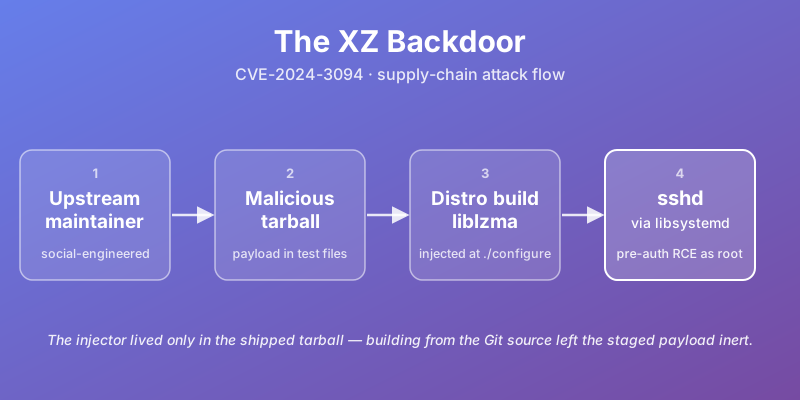
Here's the detail that reframes everything. The pieces of the malicious payload that did live in the XZ Utils Git repository were disguised as binary test fixtures — files nobody reads — and the mechanism that turned them into a backdoor wasn't in the repository at all. If you cloned the repo and read the source, nothing looked wrong.
The backdoor was armed through the release tarball — the packaged .tar.gz that maintainers publish and that distributions actually download to build their packages. And it was staged, in pieces, in places nobody thinks to review:
- Two "test" files, committed to the Git repository itself under
tests/files/, that were supposed to be corrupt/malformed compression samples:bad-3-corrupt_lzma2.xzandgood-large_compressed.lzma. To a reviewer, these are exactly what a compression library's test suite should contain — deliberately broken binary blobs used to exercise error handling. In reality they held the obfuscated, compressed stages of the exploit, hiding in plain sight in version control. - A modified
build-to-host.m4macro in the tarball's build tooling — the one piece that existed only in the generated tarball, never in the tracked repository. During./configure, this macro quietly extracted and decompressed the payload from those "test" files and injected it into the build.
This is the crux of the whole thing. Autotools projects ship a generated tarball that differs from the source tree — it contains configure scripts and m4 macros produced by autoreconf. Almost nobody diffs the shipped tarball against the repository, because for decades there was no reason to. The attacker exploited that gap. The result borders on paradox: even though the payload's stages sat in the repository, if you had downloaded the source from Git and built it yourself, you would not have been vulnerable — without the tarball's injector, those staged files were inert. The poison was only armed in the convenience path everyone actually uses.
How the Payload Actually Fired
The build-time injection is only half the cleverness; the runtime activation was just as deliberate.
The extracted code hooked into the build via an IFUNC resolver — a legitimate glibc mechanism for selecting an optimized function implementation at load time. The backdoor used it to redirect a symbol so that when the compromised liblzma was loaded into a process, it could reach in and replace OpenSSH's RSA_public_decrypt handling.
Why OpenSSH, when OpenSSH doesn't depend on liblzma at all? Because several distributions patch sshd to integrate with systemd's notification socket, and libsystemd pulls in liblzma. So on exactly the systems the attacker cared about — Debian- and RPM-based servers running patched OpenSSH — liblzma got loaded straight into the most security-critical daemon on the box. Once there, the backdoor watched authentication attempts for a payload signed with the attacker's private key and, on a match, executed arbitrary commands as root, before authentication completed. No credentials, no logs of a failed login — just a pre-auth master key.
The activation logic was also gated. It checked that it was running during a distro package build (looking for the tooling and environment of dpkg/rpm), that the target was x86-64 Linux, and other conditions. This is why it slipped through: build it any other way, on any other platform, or run it outside the exact intended context, and the backdoor stayed dormant. It was engineered to be invisible everywhere except where it mattered.
The Slow Con: Two Years of Social Engineering
The technical payload is impressive. The human engineering around it is the part that genuinely changes how I think about open source.
XZ Utils was, like a shocking amount of critical infrastructure, maintained largely by one volunteer — Lasse Collin — doing it in his spare time. The attack against that maintainer played out over roughly two years:
- 2021–2022: An account under the name "Jia Tan" (
JiaT75) began contributing to the project. The early patches were legitimate and useful. This is patient reputation-building — the contributor made themselves genuinely helpful. - The pressure campaign: A cluster of other accounts — names like "Jigar Kumar" and others that never appeared anywhere else — showed up in the mailing lists complaining that patches weren't being merged fast enough and openly pushing for the project to add a co-maintainer. They leaned on Collin, who had been candid about being overloaded and dealing with his own mental-health limitations. These sockpuppets were almost certainly the same operation, manufacturing the social pressure to justify the next step.
- The handoff: Worn down and short on time, Collin granted "Jia Tan" increasing responsibility and eventually maintainer-level access. A trusted position that took years to establish was captured by someone who had built that trust specifically to abuse it.
- The strike: With release authority in hand, "Jia Tan" cut the 5.6.0 and 5.6.1 releases containing the staged backdoor and pushed to get them into distributions quickly — even nudging downstreams to pick up the new version.
It failed only because of a performance regression an unusually careful engineer refused to ignore. That's the whole margin. Not a code review, not a scanner, not a policy — one person's irritation at half a second of latency.
Why This One Is Different
We see supply-chain incidents regularly now — typosquatted npm packages, compromised credentials pushing malicious updates, dependency confusion. The XZ backdoor stands apart for a few reasons that are worth naming precisely:
- It targeted the trust model, not a bug. There was no vulnerability to patch in the traditional sense. The attacker didn't exploit a flaw; they became the trusted party. You can't scan your way out of that.
- The audited artifact and the shipped artifact diverged. Source review — the thing we hold up as open source's core safety property — was structurally bypassed: the payload's stages hid in binary fixtures no review process reads, and the injector that wired them into the build never appeared in the reviewed source at all.
- It hid in exactly the files reviewers are trained to skip. Binary test fixtures and generated build macros are the last place anyone looks, which is precisely why they were chosen.
- The patience was industrial. A two-year investment in a single low-profile dependency implies a well-resourced actor treating open-source maintainership as an attack surface to be cultivated. This wasn't a smash-and-grab.
The Practical Lessons
I don't think the takeaway is "open source is unsafe." Open source is the reason this was caught at all — the code was inspectable, the mailing-list history was public, and once the alarm went up the whole thing was reconstructed in days. A closed equivalent might never have surfaced. But the incident does demand some concrete changes in posture.
Reproducible builds are no longer optional. The single most effective defense here is being able to deterministically build an artifact from tracked source and verify byte-for-byte that it matches what shipped. If the release tarball can't diverge from the repository without detection, this entire class of attack collapses. Projects should build from clean source, not pre-generated tarballs, wherever possible.
Distrust the generated tarball. Autotools-style shipped archives that contain files absent from version control are a liability. Diff the tarball against the repo, or better, regenerate the build system from source in your own pipeline instead of trusting the maintainer's configure.
Treat test fixtures and build scripts as executable code — because they are. Binary blobs in a test directory and m4 macros in a build system get a pass in review that they haven't earned. Anything that runs, or that runs other things, during build or test deserves the same scrutiny as the library's core.
Fund and staff critical dependencies. The root enabler was a burned-out solo maintainer with no backup. The "nebraska problem" — that XKCD comic about one person in Nebraska thanklessly maintaining a load-bearing dependency — stopped being a joke here. Sustained funding and genuine co-maintainer support aren't charity; they're security controls. A maintainer who isn't overwhelmed is far harder to socially engineer.
Watch the contributor, not just the contribution. A brand-new pressure campaign from accounts with no history, all pushing in the same direction, is a signal. So is a rapid escalation from helpful patches to release authority. Provenance and reputation deserve to be part of the threat model.
Anomaly detection has value even when signatures don't. No scanner had a rule for this. What caught it was a human noticing that behavior didn't match expectations — extra CPU, extra latency. Keep the baselines that let you notice "this got slower for no reason," and keep engineers who are allowed to chase that thread.
The Takeaway
CVE-2024-3094 is the rare security story where the interesting part isn't the exploit — it's everything around it. A patient adversary spent years becoming trusted, then hid a backdoor in the one artifact nobody diffs, staged through files nobody reviews, activated only in the context they cared about, and pointed straight at root on a huge swath of servers. The defense that saved us was not a tool. It was a single stubborn engineer.
That's not a comforting margin, and we shouldn't build a security posture around getting lucky again. The durable fix is structural: make the shipped artifact provably equal to the audited source, treat build and test tooling as the attack surface it is, and stop letting the world's critical infrastructure rest on the unpaid patience of one person. Open source's transparency is a genuine strength — but transparency only protects you if the thing you can see is the thing you actually run.
Sources and further reading
- Akamai — Critical Linux Backdoor in XZ Utils Discovered: What to Know
- WIRED — The XZ Backdoor: Everything You Need to Know
- Pentest-Tools — XZ Utils Backdoor (CVE-2024-3094)
- Securelist (Kaspersky) — The XZ Backdoor Story, Part 1
- JFrog — XZ Backdoor Attack CVE-2024-3094: All You Need to Know
- Gynvael Coldwind — technical analysis of the XZ backdoor
- Low Level — "Secret backdoor found in open source software (xz situation breakdown)"
- Low Level — "Revealing the features of the XZ backdoor"
- Fireship — "Linux got wrecked by backdoor attack"
- NVD — CVE-2024-3094